
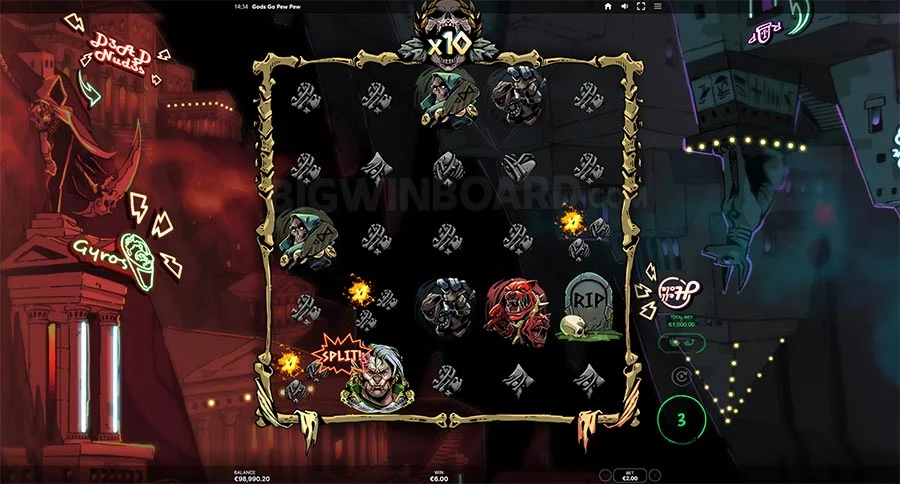

Gods Go Pew Pew is a peculiar title from software provider Sneaky Slots. It’s an online slot that pits two deities associated with death—the Egyptian jackal-headed god Anubis and the Greek personification of death, Thanatos—against one another in an eternal war.
We tested this game to see if the “pew pew” mechanics and the unique clash of mythologies translate into a playable, fair experience, or if it’s just another gimmick wrapped in a strange title. Here is our breakdown of how the game actually functions during real play.
Gods Go Pew Pew is a mythology-themed slot from Sneaky Slots featuring Anubis and Thanatos in a chaotic battle. Built on a 5×5 grid with 50 paylines, the game blends high volatility with laser-based bonus mechanics and multiple feature variations.
Gods Go Pew Pew Overview
This slot operates on a 5×5 gaming grid ringed with bones, featuring 50 paylines that connect winning combinations from the leftmost reel. The theme is a mix of ancient mythology and modern warfare, starting with a subdued tone before cranking up the soundtrack and visuals as the game progresses.
Basic Facts:
- Developer: Sneaky Slots
- Theme: Ancient Mythology / War (Anubis vs. Thanatos)
- Grid / Reels: 5×5 grid
- Pay System: 50 paylines
- Max Win: 9,999.9x the bet
- Bet Range: $/€0.10 to $/€40
The symbols include standard low-paying card suits (clubs, diamonds, hearts, spades) and four high-paying picture symbols. Bone Wilds are also present, substituting for pay symbols. While the premise is somewhat absurd—gods shooting lasers at each other—the execution shifts from a quiet, bongos-in-the-background atmosphere to a more intense visual experience during the bonus rounds.
How the Game Plays in Real Sessions
During our testing, the base game felt somewhat reserved initially. The two gods circle each other, and while wins do occur, the game has a “slow burn” quality.
Early Behavior & Hit Frequency:
The game operates with a highly volatile math model. In the base game, you are mostly waiting for the two God symbols to land. When they do, they transform into Bone Wilds. The real interest in the base game comes when both symbols land simultaneously. Depending on their position (diagonal, horizontal, or vertical), they transform symbols between them into wilds. This adds tension, but between these moments, play can feel a bit dry.
Balance Movement:
Because of the high volatility, balance swings were noticeable. The “Split” feature (Thanatos splits symbols) and “Swap” feature (Anubis upgrades symbols) help mitigate losses, but they don’t trigger on every spin. The xZone feature, which adds multipliers from x2 to x50, is elusive in the base game. It often feels like the base game is just a holding pattern while you wait for the bonus rounds where the actual potential lies.
Gods Go Pew Pew RTP and Volatility in Practice
The statistical profile of Gods Go Pew Pew suggests a high-risk, high-reward environment.
- Official RTP: 95.8%
- Declared Volatility: High
- Observed Variance: The observed variance aligns with the high volatility rating. You can go through periods of dead spins or low returns while waiting for the feature triggers.
Session Risk:
This is not a low-risk slot. The RTP of 95.8% is slightly below the industry average of 96%, though not drastically so. However, combined with the high volatility, players should expect their bankroll to fluctuate significantly. The game relies heavily on the bonus rounds to deliver substantial returns, meaning short sessions might result in losses if a bonus isn’t triggered.
Gods Go Pew Pew Bonus Features and Free Spins
The game offers four main variations of bonus games, split between “Dead Spins” and “Lazer Tag,” along with “Super” versions of each. These are triggered by landing 3 Hourglass symbols (or a Golden Hourglass for the Super versions).
Dead Spins:
This feature awards 7 free spins with an active Skull Multiplier that increases when God symbols transform other symbols. The multiplier resets after every spin in the standard version. In the “Super Dead Spins” version, the multiplier does not reset. During testing, the Super Dead Spins provided the best results due to the persistent multiplier.
Lazer Tag:
This is a more interactive feature where gods shoot lasers at each other. Multipliers increase as lasers hit targets or pass through gates. A Skull symbol doubles accumulated multipliers if both eyes are activated. The round ends when a god is hit 7 times. While visually flashier than Dead Spins, it requires more attention to track. The “Super” version starts multipliers at 5x and adds extra lasers.
Sneaky Boosts:
The game includes options to pay extra (2x or 5x the bet) to increase the chance of triggering bonuses. You can also buy into the bonuses directly for 15x (God Fight), 100x (Regular Bonus), or 500x (Super Bonus). Buying the Super Bonus is extremely high risk and should be approached with caution.
Degenious Slot Rating
Gods Go Pew Pew is an inventive title that eventually delivers on its chaotic promise, but requires patience.
Rating: 4/5 Stars
- Gameplay: The base game is a bit slow, but the mechanics of battling gods adding wilds keeps it interesting.
- Bonuses: The distinction between Dead Spins and Lazer Tag offers good variety. The Super versions are where the real math potential sits.
- Volatility: Accurate high volatility. Expect dry spells.
- Fairness: The RTP is slightly under 96%, but the mechanics function transparently.
- Overall: A solid, if slightly weird, entry that stands out from generic mythology slots.
Choose your Favorite Slot
The Stuff Everyone Wants to Know
-
What is the max win in Gods Go Pew Pew?
-
How do I trigger the Super Dead Spins?
-
Is the Lazer Tag bonus better than Dead Spins?
-
Can I buy the bonus round?
-
Does the xZone feature appear often?

